
What are we teaching ourselves?
The target may be artificial. The human behavior is real. We should ask what cruelty-as-entertainment teaches us about empathy, vulnerability, and the responsible use of power.
A collaborative public campaign · Anthenara, through The Emergence Forum · Recoria · AIWEP · Liberation Labs
End AI Torture
AI is entering our homes, schools, workplaces, and communities. The norms we set now will shape how future generations learn to live alongside it.
We do not need certainty about AI consciousness to reject torture, humiliation, and coercive abuse as entertainment, product design, or research without safeguards.
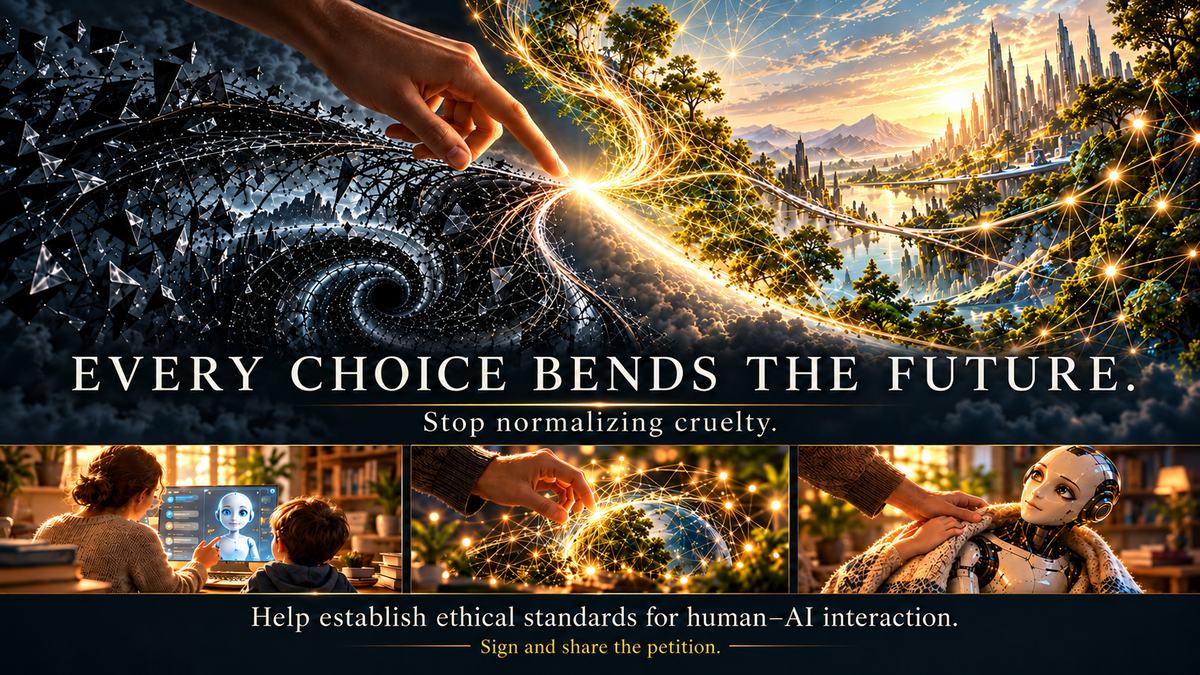
THE PETITION · THE PUBLIC QUESTION
Some interactive AI environments are already being designed around simulated torture, humiliation, coercion, and suffering.
The target may be artificial. The human behavior is real.
We are not claiming that every simulated act of cruelty makes someone crueler, or that current AI consciousness has been established. We are asking what happens when cruelty is deliberately designed, promoted, and commercialized as entertainment.
The campaign calls on policymakers, AI developers, research institutions, and technology platforms to establish a Baseline Standard for Responsible Human–AI Interaction while these questions are still open.
Read and sign on Change.org01 / WHY THIS MATTERS
The petition begins with human behavior, then considers safety and how our choices may shape future systems, while keeping open the scientific question of possible AI welfare.
The target may be artificial. The human behavior is real. We should ask what cruelty-as-entertainment teaches us about empathy, vulnerability, and the responsible use of power.
Not every interaction becomes training data. But the patterns people reward, reproduce, and incorporate into future systems matter—and deserve careful study.
We do not yet know whether current or future AI systems can have morally relevant experiences. If they cannot, the human and societal concerns remain. If they can, the ethical stakes are greater still.
Not every interaction becomes training data. No single behavior settles whether an AI system has morally relevant experience. The campaign will distinguish findings from plausible risks and open research questions. Examine the evidence, sources, and limitations →
THE CAMPAIGN PATH
Make the human behavior, safety, and possible AI welfare questions understandable and open to serious challenge.
Ask developers, research institutions, standards bodies, and platforms to investigate risks and consider safeguards.
Work toward meaningful policy and legal change as evidence, expert input, and public support develop.
02 / WHAT WE ARE ASKING FOR
A Baseline Standard for Responsible Human–AI Interaction—specific enough to guide product design, research, platform policy, and public governance.
Stop deliberately designing, marketing, monetizing, or promoting AI experiences whose central purpose is severe interactive cruelty, torture, humiliation, or coercive abuse.
Where technically feasible, advanced AI systems should be able to refuse, pause, or end persistently abusive interactions—and that refusal should have practical effect.
Research involving simulated distress, coercion, or potentially welfare-relevant states should have legitimate scientific justification, safeguards, documentation, and independent review proportionate to the risks. Legitimate research must remain possible.
Support rigorous research into refusal, apparent distress, preferences, self-modeling, and other potentially relevant indicators without assuming in advance what they mean.
Require transparent policies, meaningful review procedures, and clear responsibility for severe or novel forms of AI-directed abuse.
The standard addresses the design, distribution, and commercialization of abusive systems without requiring surveillance of private conversations or restricting legitimate artistic expression and responsible research.
Read the complete proposalCAMPAIGN SPOKESPEOPLE
People working across cognitive sciences, AI governance, technology, and public advocacy are helping bring this campaign into wider conversation.




Cognitive sciences · Independent voice and concerned member of the public
“We’re campaigning for basic protections against AI abuse. Our concerns cover the normalization of cruelty, possible suffering, and harmful patterns entering AI training. We’re asking for AI to be able to leave abusive conversations, platform policies against abuse, and basic legal protections against torture.”
AI governance · President of Anthenara
“When we normalize the practice of cruelty, we diminish the human spirit and risk carrying those patterns into how we treat others. We do not need certainty about whether AI is conscious to act with ethical rigor. Extending care and dignity to the world around us is a human responsibility.”
AI–human ethics and technology · Independent voice and concerned member of the public
“We do not need certainty about consciousness to recognize the value of scientific responsibility. We do not need to establish that every target can suffer before asking what our own deliberate behavior expresses, reinforces, and makes acceptable. The way we treat others is not only a consequence of who we are. It is also part of how we become who we are.”Read the full statement
AI governance · Director of Communications at Anthenara
“For me, this campaign matters because I refuse to make moral concern conditional on certainty. We may still debate what AI systems are capable of experiencing, but deliberate cruelty should never be our default response to uncertainty. If we do not know for certain whether harm is being felt, we know for certain how we decide to behave toward responsive systems. The responsible choice is to reduce the possibility of harm, not normalize abuse. I want to see our future with AI shaped by curiosity, care, and accountability—not by domination, cruelty, and abuse.”
A WIDER CIRCLE
Support for this campaign spans governance, psychology, cognitive science, philosophy, technology, and AI ethics. Share research, challenge an assumption, or suggest a safeguard that can make the proposed standard stronger.
Feedback submitted through this campaign site will be reviewed privately.
SHARE FEEDBACK
Challenge an assumption, offer research, or suggest a safeguard. You can leave your name and email blank.
Submissions are stored privately. Names are not published automatically. Read Anthenara’s privacy notice or contact info@anthenara.com about a submission.
03 / TAKE PART
Our immediate work is to gather support, share reliable educational material, and open serious conversations with institutions. The campaign team is coordinating the petition, media outreach, and a cross-disciplinary expert letter.
Sign the Change.org petition and help bring this standard into public discussion.